Crane operations have not fundamentally changed in decades, until now. IoT connectivity, sensor-based diagnostics, and remote operation are moving from pilot projects to standard practice. Here is what the shift actually looks like, backed by data.
The Problem Technology Is Solving
Unplanned downtime and operator-linked incidents remain the two most expensive operational problems in the lifting industry. According to the International Labour Organization (ILO), operator error accounts for roughly 45% of crane accidents globally. In India, a 2016 study by researchers at IIT Delhi and NIT Surat estimated that the construction sector accounts for approximately 25% of all workplace fatalities in the country, with crane and heavy-material handling cited as a key risk factor.
These are not abstract numbers. The August 2023 crane collapse on the Samruddhi Expressway in Maharashtra, which killed 20 workers, is a direct example of what inadequate monitoring and maintenance management can lead to on Indian infrastructure projects.
Technology’s primary value in crane operations is not a productivity gain story, it is a risk reduction story first.
| Metric | Figure | Source |
| Global crane predictive maintenance market size, 2025 | USD 184.67 million | 360iResearch, 2026 |
| CAGR forecast to reach USD 355.64 million by 2032 | 9.81% | 360iResearch, 2026 |
| Asia-Pacific share of the industrial crane market, 2024 | 43%+ | MarketsandMarkets, 2024 |
| Share of crane accidents attributed to operator error globally | 45% | ILO |
Key Adoption Areas: What the Data Shows
IoT Remote Monitoring
Real-time sensor data now tracks load cycles, motor starts, brake condition, overload attempts, and running hours directly from the crane to a connected data portal. Konecranes, for example, collects condition and usage data, transmits it to a remote data centre, and alerts designated personnel by email or SMS on critical faults, including overloads and emergency stops, as they occur.
Predictive Maintenance
Rather than waiting for a component to fail, modern systems use sensor data and AI pattern recognition to estimate the remaining service life of brakes, wire rope, and hoist mechanisms, flagging issues before they become operational stoppages. Konecranes wire rope monitoring detects internal defects invisible to visual inspection, applying ISO 4309:2017 standards to determine replacement thresholds.
Remote Operation
Crane control from outside the operating cab reduces operator exposure in hazardous zones, ports, steel plants, chemical facilities, and large-scale construction sites. Remote Support extends this further, providing 24/7 expert troubleshooting access including two-way machine communication in controlled environments.
Electric and Hybrid Systems
Diesel dependency is a growing liability, both in operating cost and in meeting the emission targets increasingly required for large infrastructure tender approvals. Cavotec’s modular battery system (2026) is designed specifically for port crane hybridisation, supporting both new equipment and retrofits of existing fleets.
Automation and Semi-Automation
Programmable lift sequences, anti-sway systems, and torque controls reduce cycle time variation and human error in repetitive, high-volume operations. Adoption is highest in automotive and steel manufacturing, and is directly applicable to workshop and EOT crane environments where throughput consistency matters.
Where Adoption Stands in India
Asia-Pacific accounts for over 43% of the global industrial crane market by revenue, with India among the fastest-growing segments, driven by infrastructure investment under the National Infrastructure Pipeline and the PM Gati Shakti programme.
Despite this, technology adoption in crane operations within India remains uneven:
| Sector | Adoption Level |
| Ports and logistics | High (~82%) |
| Steel and heavy manufacturing | Moderate-high (~71%) |
| Large infrastructure — roads, rail | Moderate (~48%) |
| Mid-scale construction | Low (~24%) |
Smart monitoring and predictive maintenance are now standard practice among large industrial operators. They remain significantly underutilised across mid-scale construction and fabrication, where, notably, the incident risk is highest.
The Operator Training Gap
With 45% of crane accidents globally linked to operator error, the equipment upgrade story is incomplete without addressing the training side. Modern systems, dashboards, automated lift sequences, VFD controls, require operators to interpret data and respond to alerts, not just control a machine. Companies that invest in equipment without parallel investment in technical competency training often find that the expected safety and productivity gains fail to materialise.
Certification under IS 15560 (Cranes Safe Use) and adherence to BIS standards remains the baseline in India. The shift toward data-capable operations is raising the bar above that baseline.
Where This Leaves the Industry
The technology is not new anymore. The question for companies is no longer whether to adopt it, but how quickly. The crane predictive maintenance market alone is growing at nearly 10% annually. Companies treating this as a future consideration are already behind peers who are using sensor data to cut unplanned downtime today.
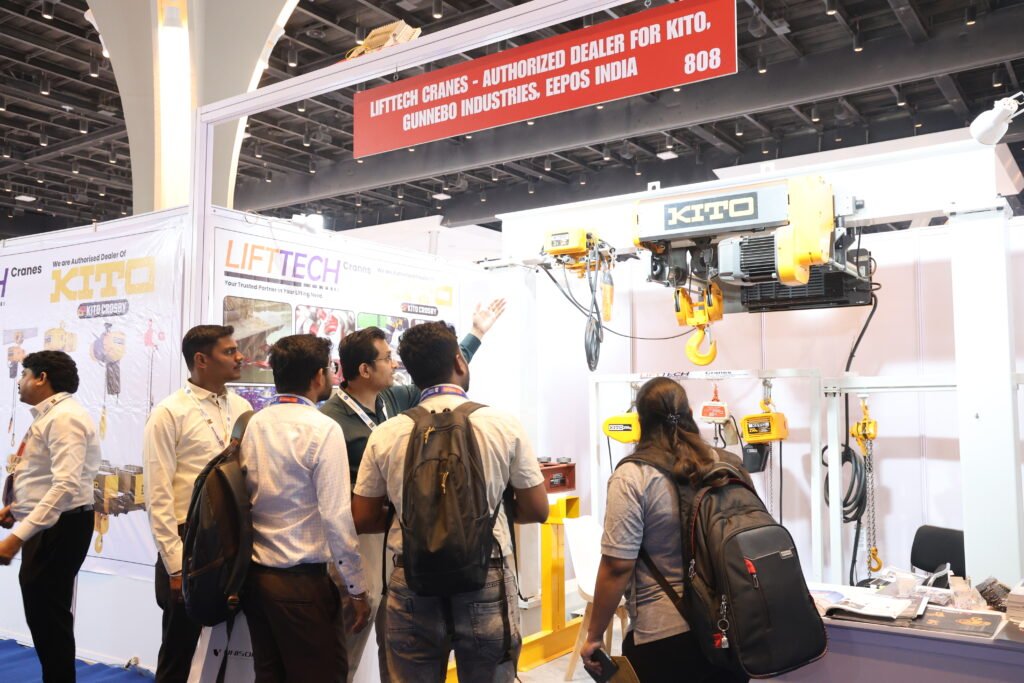
Crane Expo 2026 (Mumbai, October 27–29) will bring together manufacturers, service providers, and operators to demonstrate these technologies on the floor, offering a direct way to compare systems, understand real-world performance data, and make informed procurement decisions.